Materials That Span Miles
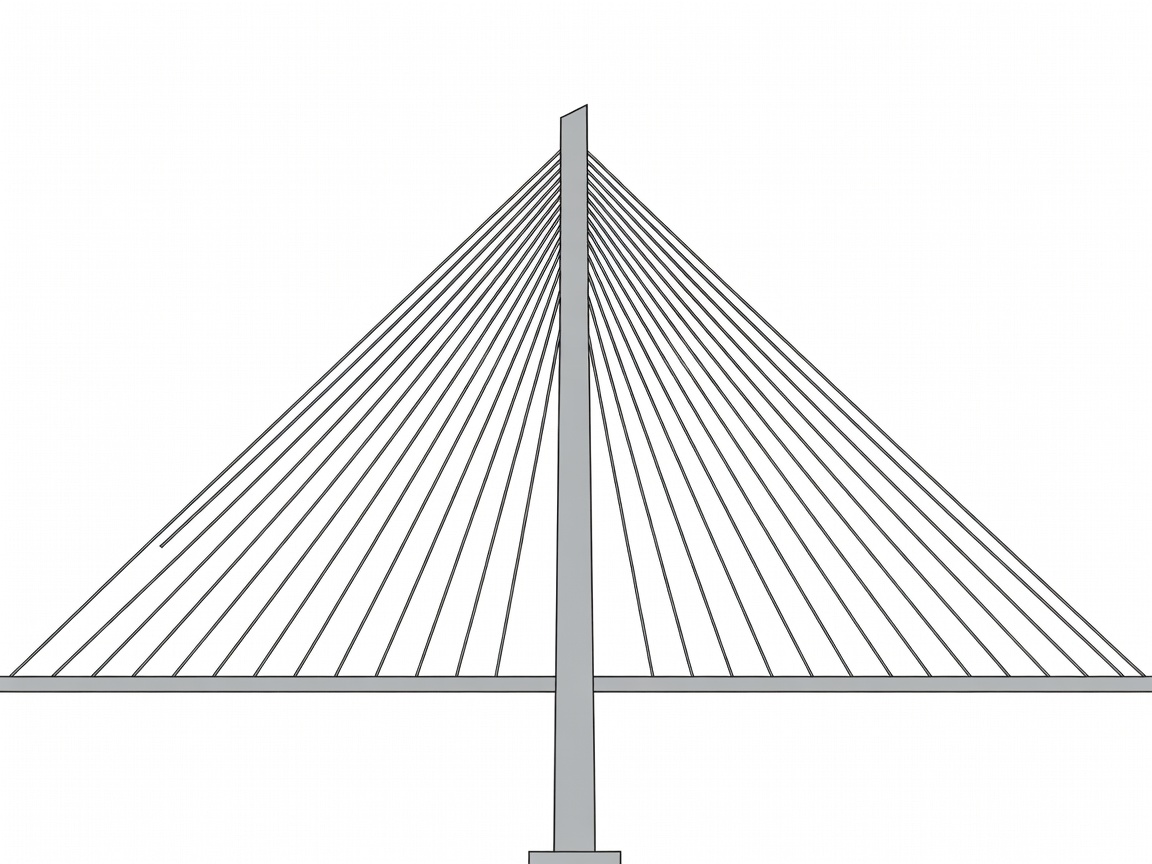
Cable-stayed bridges offer superior rigidity compared to suspension bridges for medium-to-long spans. By anchoring tension cables directly from the pylon to the deck, engineers avoid the need for massive subterranean anchorages.
Deck Compression Dynamics
In a cable-stayed structure, the cables exert both a vertical lifting force (counteracting gravity) and a horizontal pull toward the pylon. This horizontal vector places the entire bridge deck under extreme longitudinal compression. The deck acts as a continuous strut pushing against the pylons.
High-Modulus Materials
The stays themselves are constructed from bundled high-tensile steel wire, often encased in high-density polyethylene (HDPE) tubing. These wires require an exceptionally high Modulus of Elasticity—meaning they resist stretching under immense loads, ensuring the deck remains flat and rigid.
The Harp Design
Cables are attached at uniform intervals along the pylon, running parallel to one another down to the deck. While visually striking, it induces high bending moments in the pylon.
The Fan Configuration
All stays anchor near the very top of the pylon and fan out to the deck. This minimizes bending moments in the pylon (keeping it strictly in compression) but complicates the steel housing at the pylon's peak.