The Mechanics Behind Tower Bridge
Cantilever structures are defined by spans that project horizontally into space, anchored at only one end. When two such structures meet in the middle, or support a suspended central span, they form one of the most robust load-bearing systems in civil engineering.
Bending Moments and Shear Forces
The defining characteristic of a cantilever is how it handles load. At the free-hanging end, shear force is minimal, but the bending moment is zero. As you move closer to the pier (the support), the bending moment increases exponentially, maxing out right at the support point. This is why cantilever trusses are typically deepest right above the piers and taper toward the center span.
The Moveable Bascule (Tower Bridge)
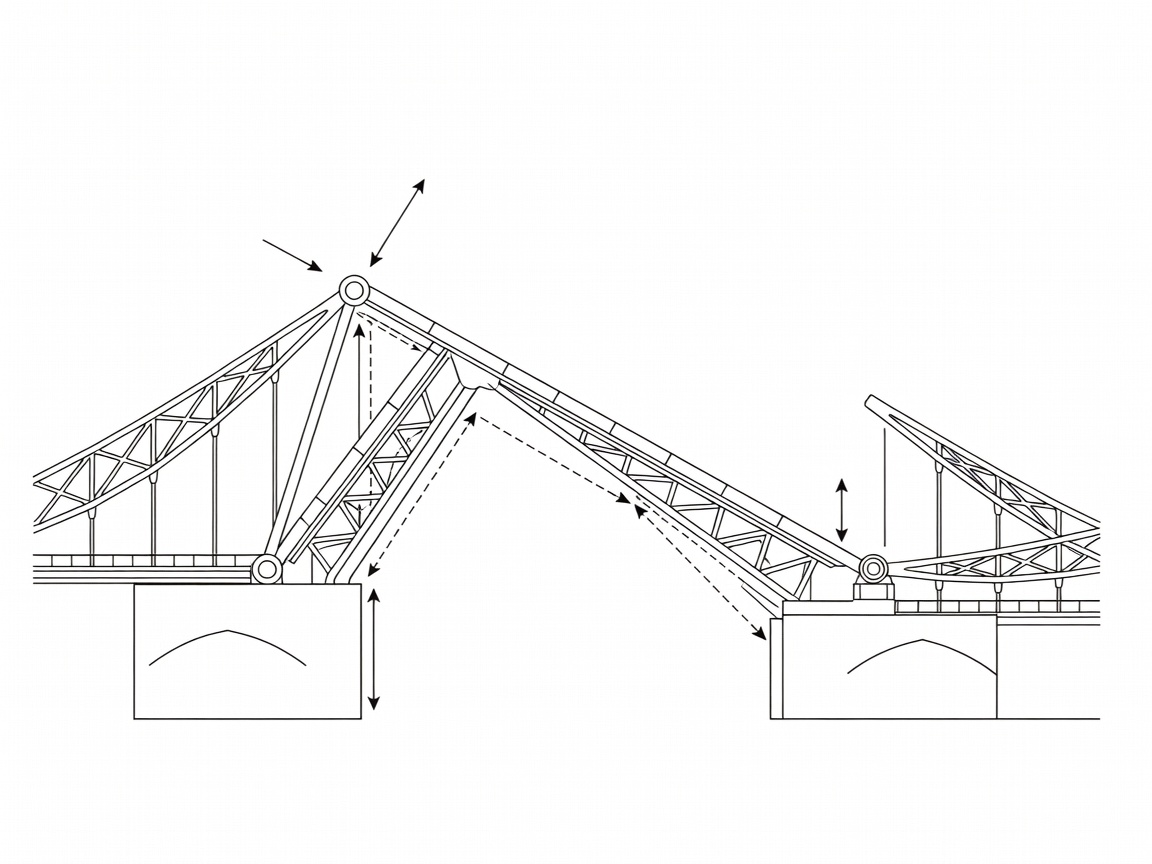
Tower Bridge in London is a combined suspension and bascule bridge. The term "bascule" derives from the French term for see-saw. Structurally, each leaf of the bascule is a cantilever.
The Counterpoise System
Inside the massive stone-clad piers are heavy lead and iron counterweights. When the bridge opens, the bascule rotates around a central pivot (trunnion). Because the mass on the tail matches the mass of the roadway leaf, minimal mechanical energy is needed to overcome inertia.
Structural Ties
To relieve lateral stress from the towers during a lift, high-level walkways act as tension ties, locking the upper geometry of the suspension chains in place while the roadway breaks in half.